

Originally introduced as a less invasive alternative to conventionally inserted central venous catheters, Peripherally Inserted Central Catheters (PICC) have rapidly become commonplace in high-acuity settings, including intensive care units.
PICC: Uses and Characteristics
PICC lines are central venous catheters inserted peripherally, typically via the basilic, brachial, or cephalic vein, with the tip positioned in the superior vena cava. Their use is widespread in both hospital and home care settings, thanks to their ability to provide long-term central venous access.
These devices are particularly suitable for the administration of intravenous medications, parenteral nutrition, blood transfusions, and repeated blood sampling, thereby reducing the need for frequent peripheral venepuncture.
Their use ensures the continuous and safe delivery of therapies while reducing complications and streamlining the work of healthcare professionals, even in critical care environments such as intensive care units.
The Importance of PICC Lines in Intensive Care
In intensive care, PICC lines offer several key advantages. Compared with central venous catheters inserted via the internal jugular or subclavian vein, PICCs present a significantly lower risk profile. The main benefits include:
- Ease of insertion: PICCs can be placed at the patient’s bedside under ultrasound guidance, which facilitates their use even in emergency situations and helps prevent treatment delays. They can be inserted without the need for an operating room
- Smooth transition between levels of care: PICCs are an effective option for intensive care patients who require prolonged venous access, as they allow intravenous therapies to continue after transfer to another ward or even after discharge, without the need for a new catheter
- Lower infection rate: When properly managed, PICCs are associated with a lower incidence of catheter-related bloodstream infections, a crucial factor for patients who are already immunocompromised
- Compatibility with respiratory support devices: PICC insertion and management do not interfere with NIV or CPAP masks, nor with prone positioning of the patient
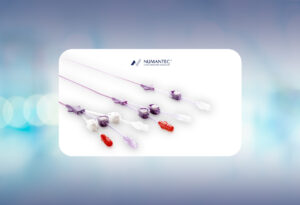
- Adaptability to patient needs: PICCs are available with one, two, or three lumens, allowing clinicians to select the most suitable configuration depending on therapeutic requirements. Multi-lumen models are particularly valuable in intensive care, where simultaneous administration of several drugs or solutions is often required
Clinical Uses of PICC Lines in Intensive Care
The use of PICC lines in intensive care allows clinicians to address a variety of clinical needs. The most common applications include:
- Infusion of high-osmolarity or irritant solutions, including antibiotics, chemotherapeutic agents, and vasoactive drugs
- Continuous infusion of sedatives or analgesics
- Total parenteral nutrition in patients who cannot be fed enterally
- Blood transfusions and multiple blood draws, reducing the need for repeated peripheral punctures
- Monitoring of central venous pressure and mixed venous oxygen saturation
- Procedures such as dialysis, apheresis, and diafiltration
Numantec Solutions for the Intensive Care of the Future
Through collaboration among leading healthcare companies, Numantec offers innovative solutions for central venous access, with particular focus on PICC lines for intensive care. These devices stand out for their quality, reliability, and ease of use, meeting the needs of the most demanding clinical environments.
Their design supports rapid and safe injection of contrast media, while features that reduce post-insertion bleeding improve catheter stability and provide excellent radiographic visibility. Manufactured from biocompatible polyurethane, they combine strength, flexibility, and patient comfort throughout the course of therapy. Each kit is designed to support clinical efficiency, with high-quality components that simplify procedures and enhance safety. Finally, the low-profile hub provides secure and discreet fixation, improving patient comfort and reducing the risk of skin irritation.
Thanks to these characteristics, Numantec PICC lines offer a comprehensive and reliable solution to ensure therapeutic continuity, safety, and patient comfort, even in the most complex intensive care settings.