
What Is A Midline Catheter?
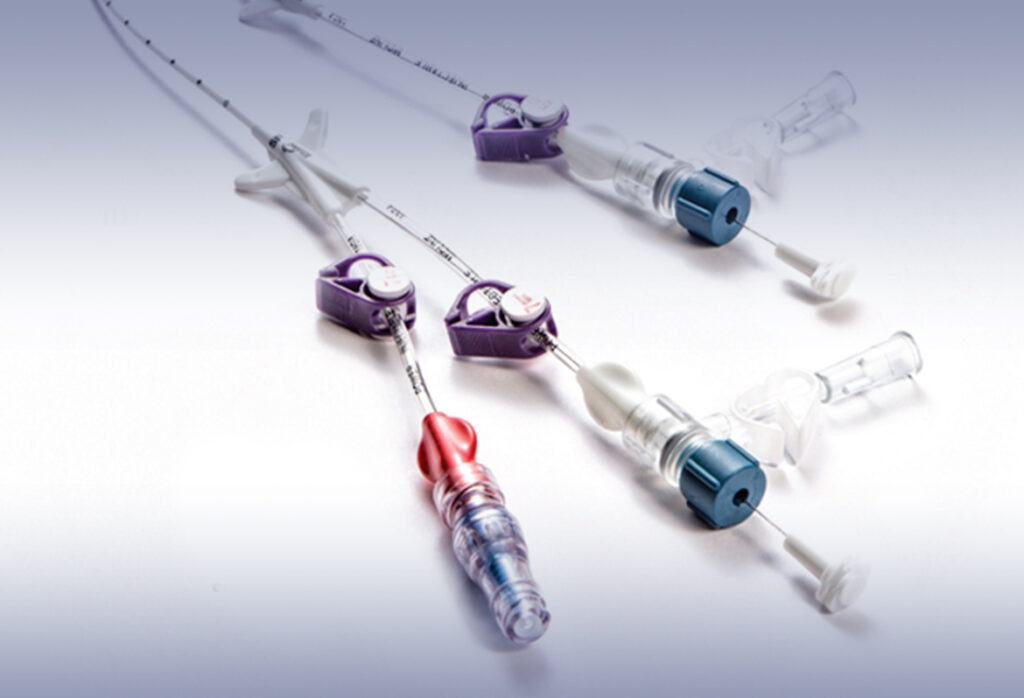
A Midline catheter is a thin, flexible tube, typically ranging in length from 8 to 20 centimeters, inserted into a peripheral vein of the upper limb—most commonly the basilic or cephalic vein—and advanced to the axillary level. Unlike a central venous catheter (CVC), which is placed in the central veins near the heart, the Midline catheter remains within the proximal peripheral veins and does not reach the central circulation.
Advantages Of The Midline Catheter
The use of a Midline catheter offers several advantages over traditional peripheral and central venous catheters. It provides stable venous access for medium-term treatments, minimizing the need for repeated venipunctures and thereby enhancing patient comfort. Compared to central catheters, the Midline is less invasive and associated with a lower risk of serious complications, such as systemic infections or pneumothorax. Additionally, it is well-suited for prolonged infusions of medications and fluids, ensuring reliable venous patency for up to four weeks while requiring a relatively simple insertion procedure.
The advantages of the Midline catheter can be summarized as follows:
- Reduced need for repeated venipunctures and lower risk of phlebitis due to insertion into larger-caliber veins
- Less invasive than a central venous catheter (CVC), with a simpler and faster insertion procedure
- Longer dwell time compared to a traditional peripheral catheter, remaining in place for up to 2–4 weeks
- Lower risk of serious complications, such as pneumothorax or systemic infections, compared to a central venous catheter
Guidelines for Midline Catheter Use
The Midline catheter is indicated for patients requiring prolonged peripheral venous access for the administration of fluids, antibiotics, analgesic medications, or peripheral parenteral nutrition. It is particularly beneficial when treatment is expected to exceed 5–7 days but does not necessitate central venous access. Additionally, it is an effective option for patients with challenging venous access, where repeated peripheral cannulation may be difficult or impractical. Major indications include:
- Administration of analgesic medications: The Midline catheter allows for the safe and effective administration of pain management drugs over an extended period
- Patients with difficult venous access: Particularly beneficial for patients with challenging peripheral venous access, where repeated cannulation with a traditional peripheral catheter is impractical. Due to its length, the Midline reaches larger-caliber veins deeper in the arm, ensuring stable and reliable venous access
- Prolonged hydration therapies: Commonly used for the infusion of intravenous medications, including antibiotics, rehydration fluids, and other long-term treatments. It is an optimal choice when the administered drugs are non-vesicant and non-irritant, eliminating the need for central venous access
- Repeated blood draws: in patients who require frequent blood draws for laboratory tests, the Midline can reduce the need for continuous venous punctures, facilitating safe vascular access and minimizing venous trauma
- Short- or mid-term peripheral parenteral nutrition: although total parenteral nutrition (TPN) is generally administered via a central venous catheter, in selected cases of partial or short-term parenteral nutrition, the Midline can be used as a temporary option, reducing the risk of central catheter-related complications
Contraindications
Although the Midline catheter is a versatile option for many patients, it is not suitable for all clinical situations. It is contraindicated for therapies requiring high infusion pressures or the administration of solutions with high osmolarity or extreme pH, such as chemotherapy agents or certain highly concentrated intravenous solutions. Additionally, it should not be used in patients with anatomical abnormalities of the veins, local infections, or severe coagulopathies, as these conditions may increase the risk of complications.
The main contraindications therefore involve:
- Administration of vesicant or highly irritating drugs: Chemotherapy agents and other medications that require central venous access to prevent tissue damage
- High-pressure infusion therapies: Such as the rapid administration of large fluid volumes, which may exceed the catheter’s pressure tolerance
- Patients with local or systemic infections: Presence of local infections at the insertion site or systemic infections that could increase the risk of catheter-related complications
Midline Catheter Insertion Procedure
The insertion of a Midline catheter is a semi-invasive procedure that requires specialized training and advanced skills to ensure both patient safety and optimal catheter placement. To minimize the risk of infection, the procedure must be performed under strict aseptic conditions. The following are the key steps for proper catheter insertion.
- Patient preparation: Before proceeding with Midline catheter insertion, it is important to properly prepare the patient. Preparation includes an explanation of the procedure to the patient (to reduce anxiety and obtain informed consent), positioning the patient supine, with the arm extended laterally on a stable plane, and determining the limb on which to perform the insertion (usually the nondominant arm, to minimize discomfort)
- Vein selection: Proper vein selection is critical for procedural success. The basilic, brachial, and cephalic veins are the most commonly used veins for Midline catheter insertion. Ultrasound guidance is recommended to identify a vein of appropriate caliber and depth, reducing the risk of complications:
– Basilar vein: Preferred due to its larger caliber and relatively straight course
– Brachial vein: Can be used but requires caution to avoid proximity to nerves and arteries
– Cephalic vein: An alternative option, though its tortuous course can make catheter placement more challenging - Preparation of the insertion site: The insertion site is thoroughly cleaned to reduce infection risk; the skin is disinfected with an antiseptic, and a sterile field is placed around the area to maintain sterility during the procedure
- Catheter insertion: The modified Seldinger technique is used, involving a needle and a guidewire to facilitate catheter placement. Ultrasound guidance can improve accuracy and reduce the risk of complications
- Verification of catheter position: Once the catheter is inserted, its position is verified by aspirating blood and flushing with saline to confirm correct placement and functionality. In some cases, ultrasound guidance may be required to ensure precise catheter positioning
- Catheter fixation: After confirming the correct catheter placement, it is secured to the skin using sterile patches or specialized fixation devices. A sterile transparent dressing is then applied to protect the insertion site from external contamination
- Monitoring and maintenance: Following insertion, the Midline catheter requires regular maintenance to prevent infections and complications
Potential Complications
The insertion of a Midline catheter is generally considered safe; however, like all medical procedures, it carries certain risks. Despite its benefits, potential complications can arise, making it essential for healthcare professionals and patients to be aware of these risks to ensure prompt identification and management. The most common complications include infection, catheter occlusion, phlebitis, thrombosis, and dislocation.
Infections
Although the risk of infection is lower than with central venous catheters, it remains a potential complication, particularly if strict aseptic techniques are not followed during insertion and maintenance. Maintaining proper hygiene at the insertion site and closely monitoring for signs of infection are essential to prevent the development of local or systemic infections.
Catheter Occlusion
Catheter occlusion is a common complication that may result from the formation of blood clots within the device. To prevent occlusion, regular flushing with saline solution is recommended to maintain catheter patency and ensure effective infusion.
Phlebitis
Phlebitis, or inflammation of the vein, can occur due to irritation caused by the catheter. This complication is more frequent when the catheter is inserted into small-caliber veins or remains in place for an extended period.
Thrombosis
Although rare, Midline catheter use may lead to thrombus formation within or around the catheter, potentially resulting in deep vein thrombosis. The risk increases with prolonged catheter dwell time. Patients should be monitored for symptoms such as swelling, pain, or redness in the affected limb, which may indicate thrombosis.
Dislocation
Accidental dislodgement of the catheter can compromise the effectiveness of infusion therapy and increase the risk of vascular irritation.
Duration Of Use
The Midline catheter is designed for medium-term use, typically ranging from 2 to 4 weeks, although its duration may vary based on the patient’s condition and the prescribed therapy. It offers greater longevity than a standard peripheral venous catheter, which is generally suitable for only a few days.
Midline: An Effective and Safe Solution
The Midline catheter provides a safe and effective option for medium-term venous access in a wide range of patients, offering distinct advantages over both traditional peripheral and central venous catheters. Proper insertion requires specialized training and must be performed under strict aseptic conditions to minimize the risk of complications. Regular monitoring and maintenance are crucial to ensuring optimal catheter function and preventing complications such as infection or thrombosis.